
INVESTMENT THEMES - January 2026
Brian Goodstadt, CFA
Chief Investment Officer
The AI Boom Drives Valuations to Near All-Time Highs
McKinsey estimates that AI investment will total $5.2 trillion over the next five years. Bain suggests that to justify this spending, AI data centers would need to generate roughly $2 trillion in annual revenue by 2030, a 100-fold increase from today’s $20 billion in revenues. As major technology companies shift from historically asset-light business models to capital intensive ones, the sector’s risk profile and valuation dynamics are changing meaningfully.
According to JP Morgan, about 45% of public companies in the U.S. have some degree of AI exposure, compared with only 10% in the Eurozone. Vanguard estimates that the U.S. currently hosts roughly 7,000 private AI start-ups, nearly double the total number of publicly traded companies across all sectors in the country. The competitive landscape is likely to intensify.
The rapid AI boom over the past few years has driven stock valuations to levels near historic highs, as shown below. Notably, this increase has been far less pronounced among smaller companies and international stocks. Some of today’s elevated valuations are supported by stronger fundamentals. Free cash flow margins in the technology sector have more than doubled since the late 1990s, indicating that tech companies today are far more profitable and resilient than during prior cycles. And as we discussed in our Economic Review, corporate profit margins are near all-time highs and recessions have become less frequent, factors that can support higher valuation multiples.
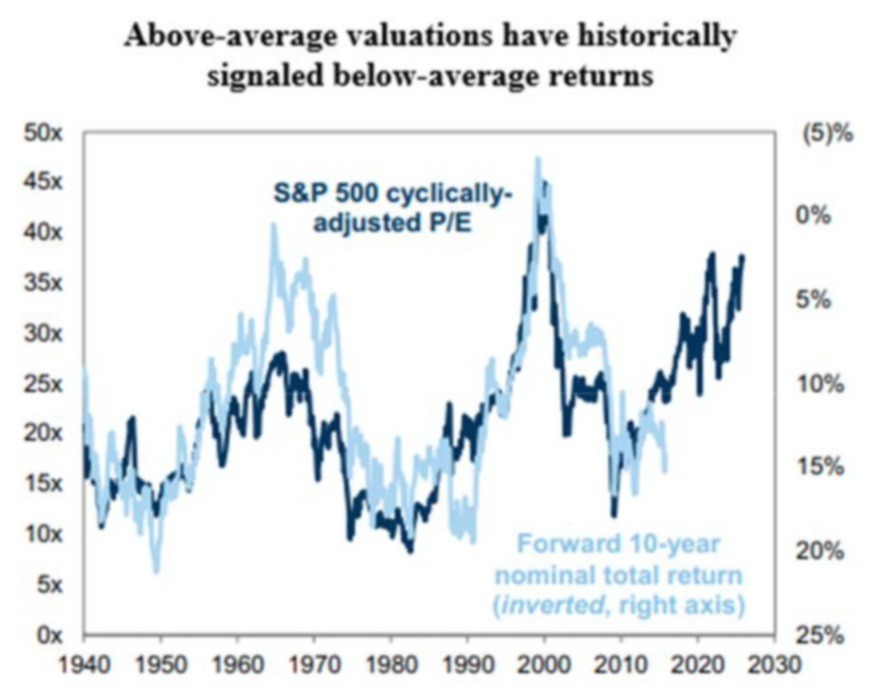
Source: Robert Shiller, Goldman Sachs Global Investment Research
While AI is transformative, the market’s enthusiasm has concentrated risk. Our portfolio positioning reflects that dynamic. To put today’s environment into perspective, it is helpful to compare the current wave of innovation and investor enthusiasm with another period of rapid technological change, the original Roaring ’20s.
Roaring ‘20s Redux?
Andrew Ross Sorkin’s recent book 1929 highlights clear parallels between today’s environment and the original Roaring ‘20s, when transformative technologies and investor speculation fueled an extraordinary market boom. A century ago, innovation included radio, automobiles, phones, electrical appliances, penicillin, and the expansion of consumer credit. Today, enthusiasm for AI is reflected in the fact that more than half the companies trading on the Nasdaq, primarily technology firms, are currently unprofitable.
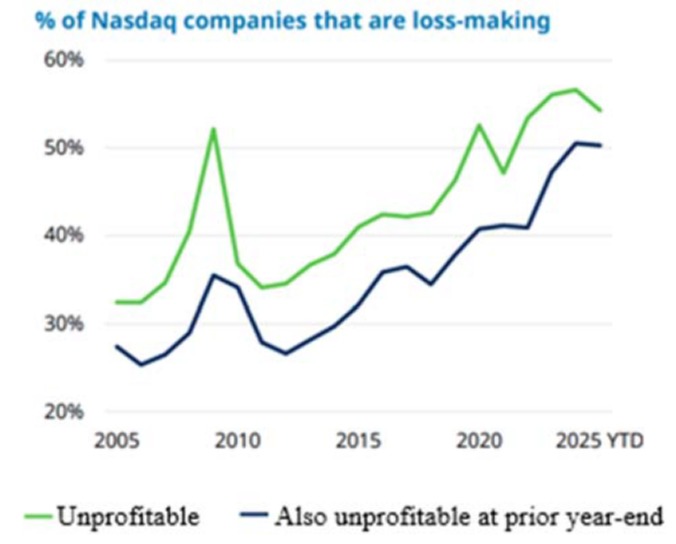
Source: Schroders
Despite these similarities, the structural backdrop today is far stronger. In the 1920s, the development of consumer credit extended to stock speculation. Investors could buy shares with only 10% down and 90% borrowed. Margin debt as a percentage of market capitalization was four to five times higher than it is today, which amplified losses and contributed to the market crash.
Regulation and safeguards were also minimal in that era. There was no SEC, no accounting or disclosure standards, limited monetary tools, no bank deposit insurance, and no restrictions on insider trading. Market data was sparse and markets were far less efficient. By contrast, today’s largest technology firms are cash-rich, regulatory frameworks are robust, policymakers intervene more rapidly, and recessions occur less frequently. These factors make today’s environment more resilient than that of a century ago.
Even with this stronger backdrop, today’s elevated valuations have important implications for long-term return expectations, which we outline in the forecasts below.
Long-Term Asset Class Forecasts
Elevated valuations imply below-average expected returns for U.S. stocks over the coming decade. Vanguard’s long-term forecasts shown below indicate that achieving the historical 10% annualized equity performance will be challenging from today’s starting point.
However, areas that have lagged in recent years, such as international equities, U.S. value stocks, and U.S. small-cap stocks, show comparatively stronger long-term potential. Bond returns should be closer to historical norms, supported by higher starting yields than a few years ago. Importantly, long-term interest rates are higher today than when the Federal Reserve began cutting short-term rates in September 2024, improving the outlook for fixed income.
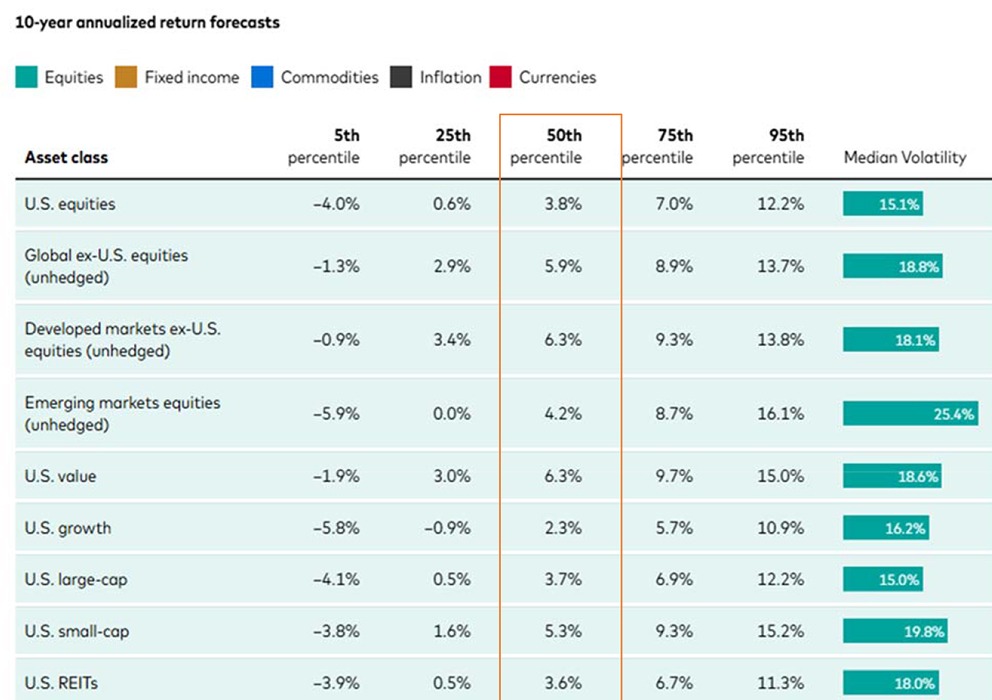
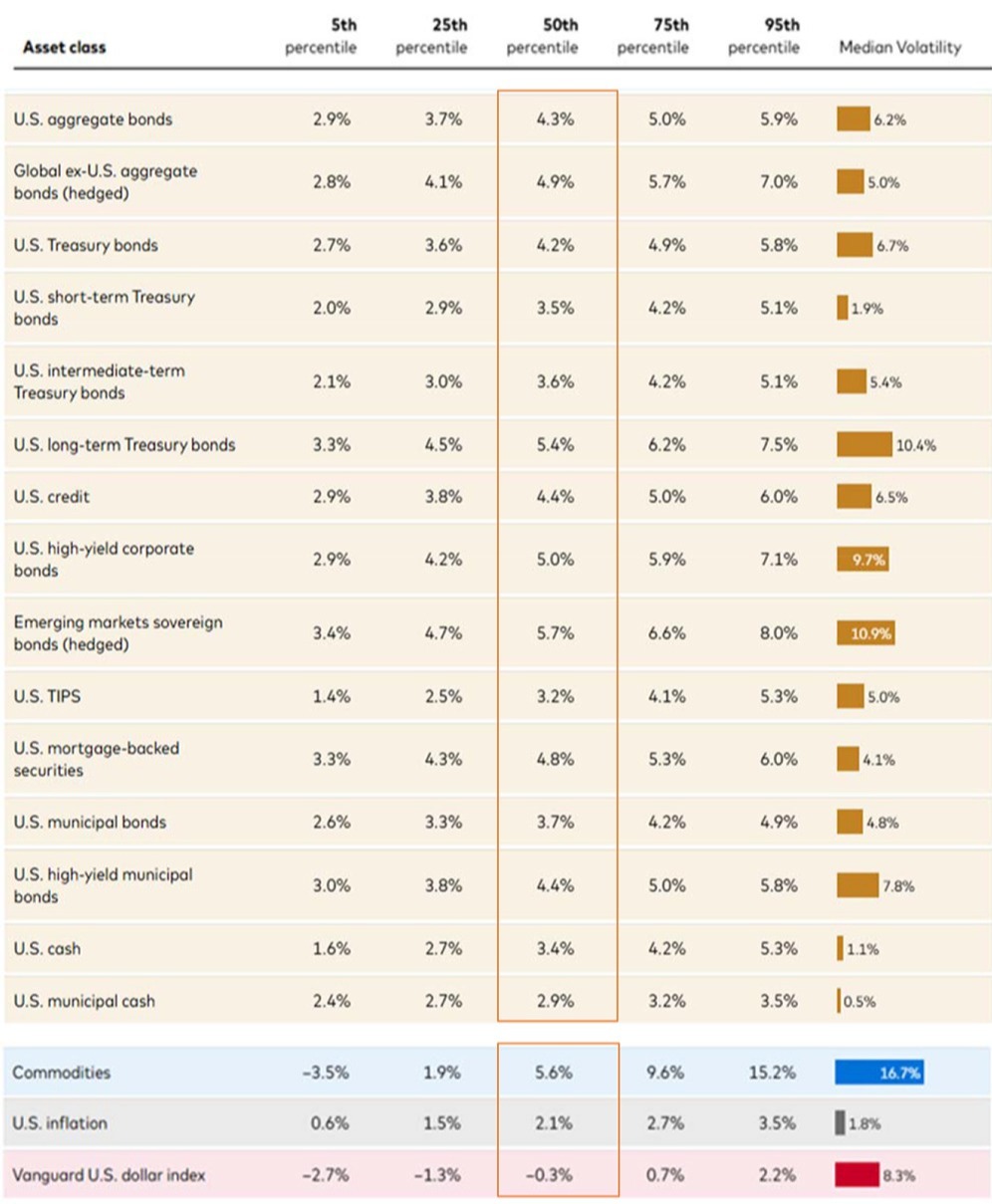
Source: Vanguard
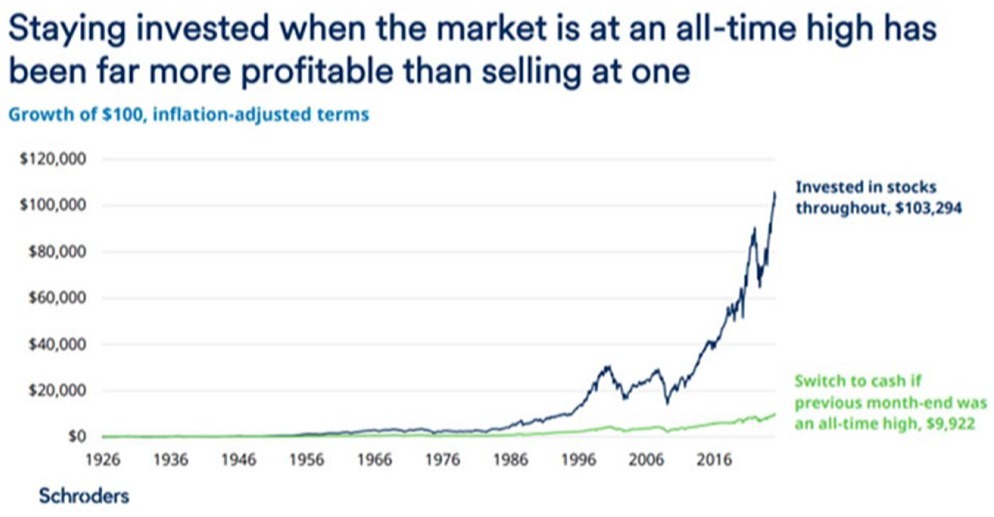
These long-term projections matter only if investors remain consistently invested, which is why disciplined participation, rather than market timing, is critical. Despite the backdrop of higher valuations and lower projected long-term returns, history consistently shows that staying invested is more rewarding than attempting to time the market. The data in the following chart is clear that investors who remain invested significantly outperform those who sell at market highs and wait for a pullback before re-entering.
Conclusion and Strategy
Taken together, these themes reinforce the importance of a steady, valuation-aware approach to portfolio construction. Warrant Buffet famously said that “the stock market is a device for transferring money from the impatient to the patient.” Our investment philosophy reflects that mindset. Paragon’s approach emphasizes discipline, broad global diversification, and a tilt toward high-quality assets trading at more attractive valuations, while maintaining reduced exposure to highly speculative areas, including an underweight in AI-dependent businesses.
We believe this patient, valuation-aware approach remains the most effective way to navigate a market shaped by rapid innovation, elevated valuations, and evolving economic conditions.