
Investment Themes - October 2026
Brian Goodstadt, CFA
Chief Investment Officer
Bond Market Takes Center Stage
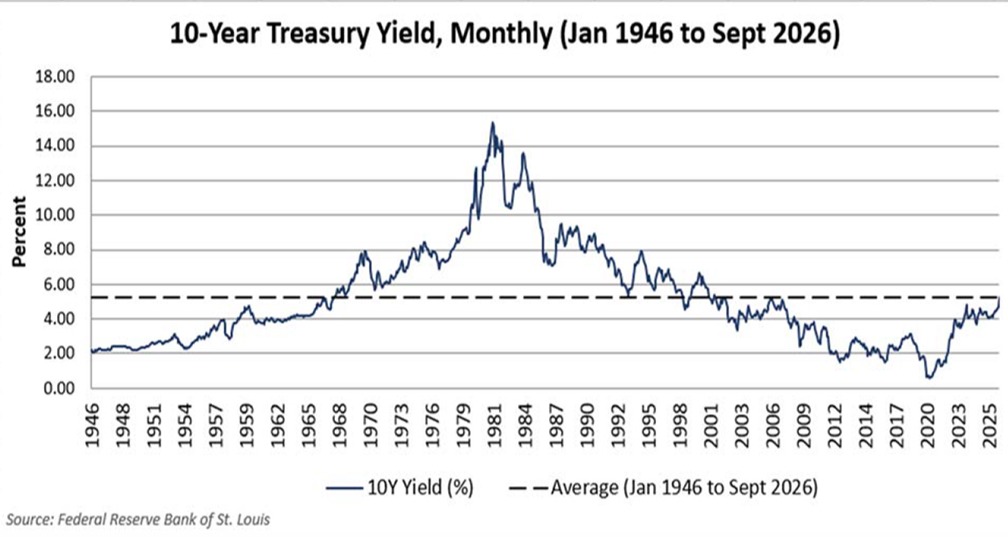
Rising bond yields have drawn considerable attention this quarter. The 10-year Treasury yield surpassed 5% in September, reaching 5.29%, its highest level since 2004, compared to just under 4% at the end of February.
Higher yields feed through to the economy via borrowing rates, including mortgage rates, which have topped 7%. Treasury Secretary Bessent has attempted to stem the rise in yields by buying back longterm Treasury bonds and intervening in currency markets to support the Japanese yen (reducing pressure on Japan to sell Treasuries to defend its currency). These interventions have had little lasting effect on yields, as they have been outweighed by the impact of inflation and structural factors such as rising supply from new issuance and persistent budget deficits.
While the common narrative is about how high interest rates are, rates have simply returned to normal. The 10-year Treasury is back to 2004 levels, when rates in this range coexisted with a booming housing market. The chart below shows an 80-year history of U.S. Treasury yields since World War II, with a long-term average of 5.24%, in line with the current rate.
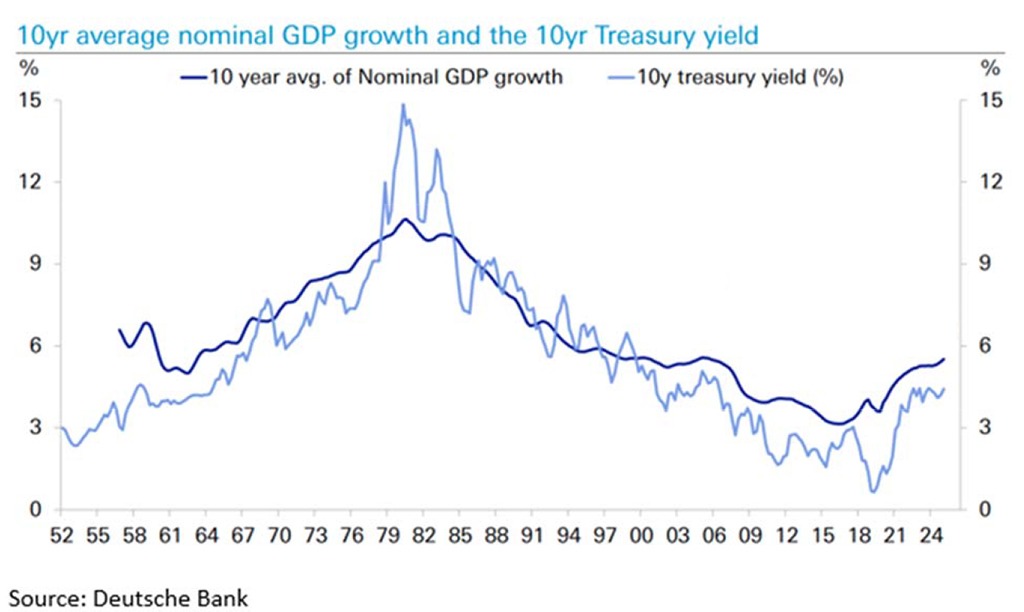
Besides the historical record, another reason rates are not abnormally high is that the 10-year Treasury tends to track nominal gross domestic product, or GDP (economic growth before adjusting for inflation). This correlation is shown clearly in the chart below, which includes about 75 years of history. Average annual nominal GDP growth over the past decade has been 5.3%. Nominal GDP growth over the past 12 months has also been 5.3%, and the consensus estimate for the next 12 months is 5.0%, indicating that today’s 5.28% 10-year Treasury yield is roughly in line with what nominal growth would suggest.
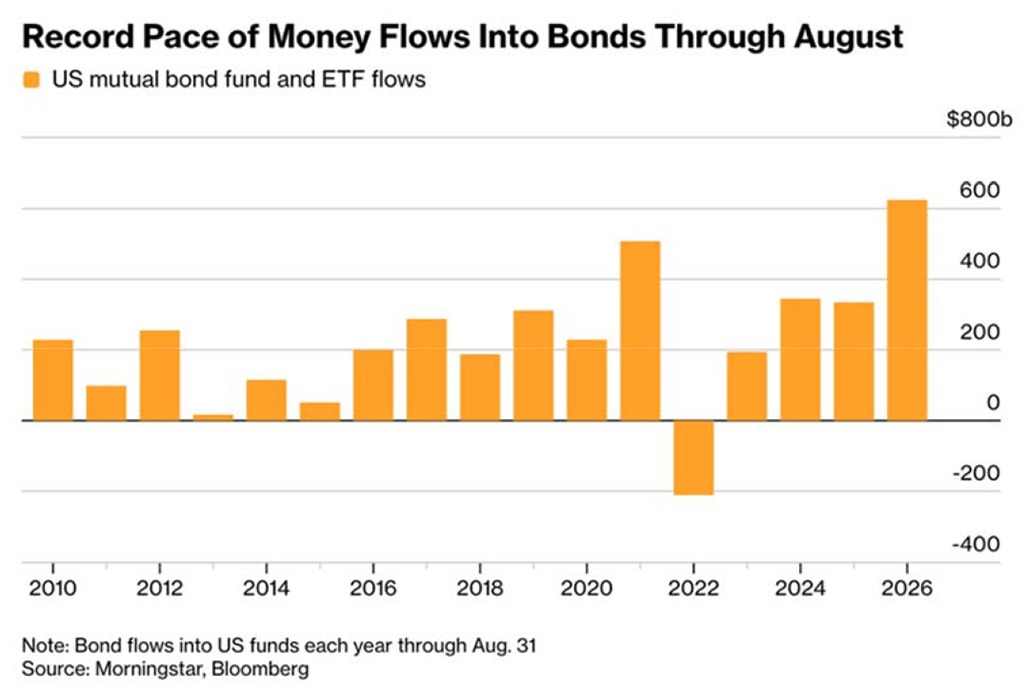
After 15 years or so of abnormally low rates, we believe bond investments have become much more attractive at today’s yields. Investors appear to agree. Unlike the 2022 yield increases, when bond funds experienced record outflows, funds have taken in more than $600 billion year-to-date through August, a record pace according to Morningstar and Bloomberg.
One risk we’ll be watching is the speed of the move up in yields. While interest rates are back to historical norms, a rapid rise can cause stress throughout the economy and for risk assets such as stocks. Sharp yield increases have historically exposed vulnerabilities in the financial system, most recently in 2023, when Silicon Valley Bank failed after losses on its bond holdings triggered a run on deposits, although that followed a larger increase in yields than the one since February.
Surging Earnings Growth and Profit Margins Are Boosting Stocks
At the start of the year, earnings growth for S&P 500 companies was projected at 15.0%, according to FactSet. This has now risen to 31.8%. An acceleration of this magnitude is typically seen only when the economy is emerging from a recession, which makes it highly unusual today. Revenue growth is projected this year at 12.1%, so the much faster earnings growth reflects record profit margins, which reached 17.0% in the second quarter, up from 12.9% a year earlier. Earnings and revenue growth are expected to slow next year to still healthy rates of 15.2% and 9.1%, respectively.
Since the stock market has risen far less than earnings growth this year, valuations on a price-toearnings basis have declined. Lower valuations make the market look less bubbly, but now the question is: are we in an earnings bubble? Growth at this pace is difficult to sustain, and the key question is where earnings settle once it slows. Because margins have driven most of this year’s gains, they are the measure we’ll be watching most closely.
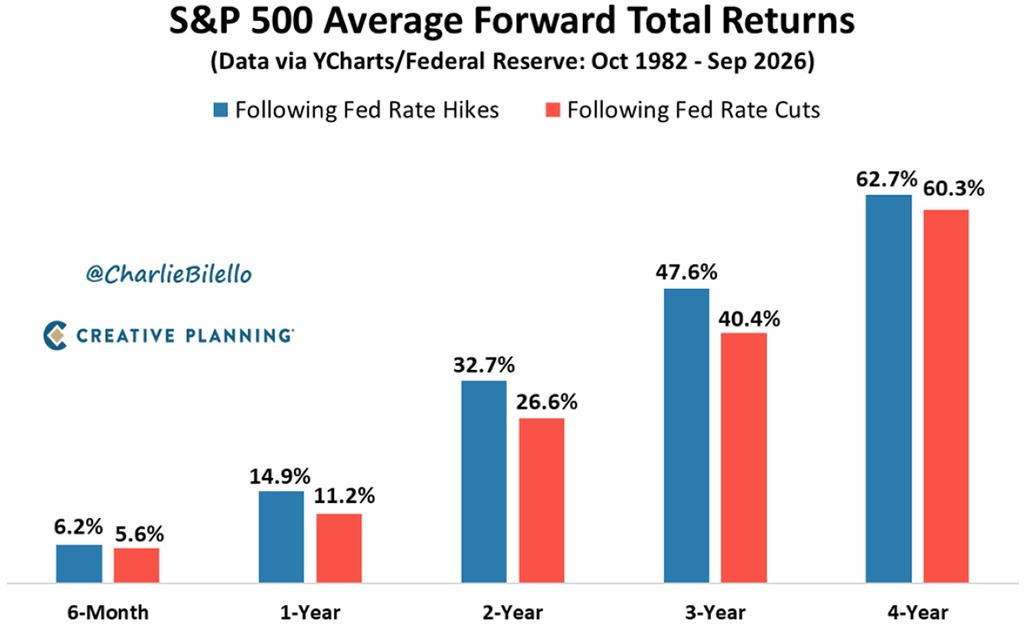
The Federal Reserve (the Fed) began a new rate-hiking cycle in September. Although higher interest rates are a negative for stock valuations, all else being equal, the evidence shows that stocks tend to perform better after Fed rate hikes than after rate cuts, as shown in the chart below, which uses data back to 1982. The first few months are typically worse than normal periods, but by the six-month mark, the performance improves. This is likely because the Fed typically raises rates when economic growth is strong.
Conclusion and Portfolio Positioning
Bonds have become more attractive relative to stocks than they’ve been in many years. Rather than chasing the stock market rally, we’ll be trimming stocks and adding to bonds.
At Paragon, our portfolios prioritize globally diversified, high-quality investments where valuations are more attractive, while underweighting more speculative segments and taking prudent risks where appropriate. We continue to add alternative investments that have low correlations to stock and bond markets. We believe this approach positions portfolios for solid long-term returns with less risk and lower volatility than the overall markets.